
HACCP Compliance Toolkit — 50 Audit-Ready Checklists & Logs for Excel and Google Sheets
Original price was: $29.99.$14.99Current price is: $14.99.
Fifty HACCP checklists, logs and registers in one Excel workbook. Cooking, cooling,
holding, sanitation, allergen changeover, traceability, supplier approval, internal
audit and management review — all with live pass/fail formulas, dropdowns and
colour-coded alerts. Built to FDA Food Code 2022, 21 CFR 117 and the GFSI schemes.
Instant download. One payment, lifetime use, no subscription.
Description
Fifty HACCP records, ready to use, in one Excel workbook
Most food businesses do not fail an audit because they lack a HACCP plan. They fail
because the records behind it are incomplete, inconsistent between shifts, or written on
a form that has not been reviewed since the last edition of the code. The HACCP
Compliance Toolkit replaces the scatter of photocopied logs with fifty structured,
formula-driven records that grade themselves as your team fills them in.
What is inside
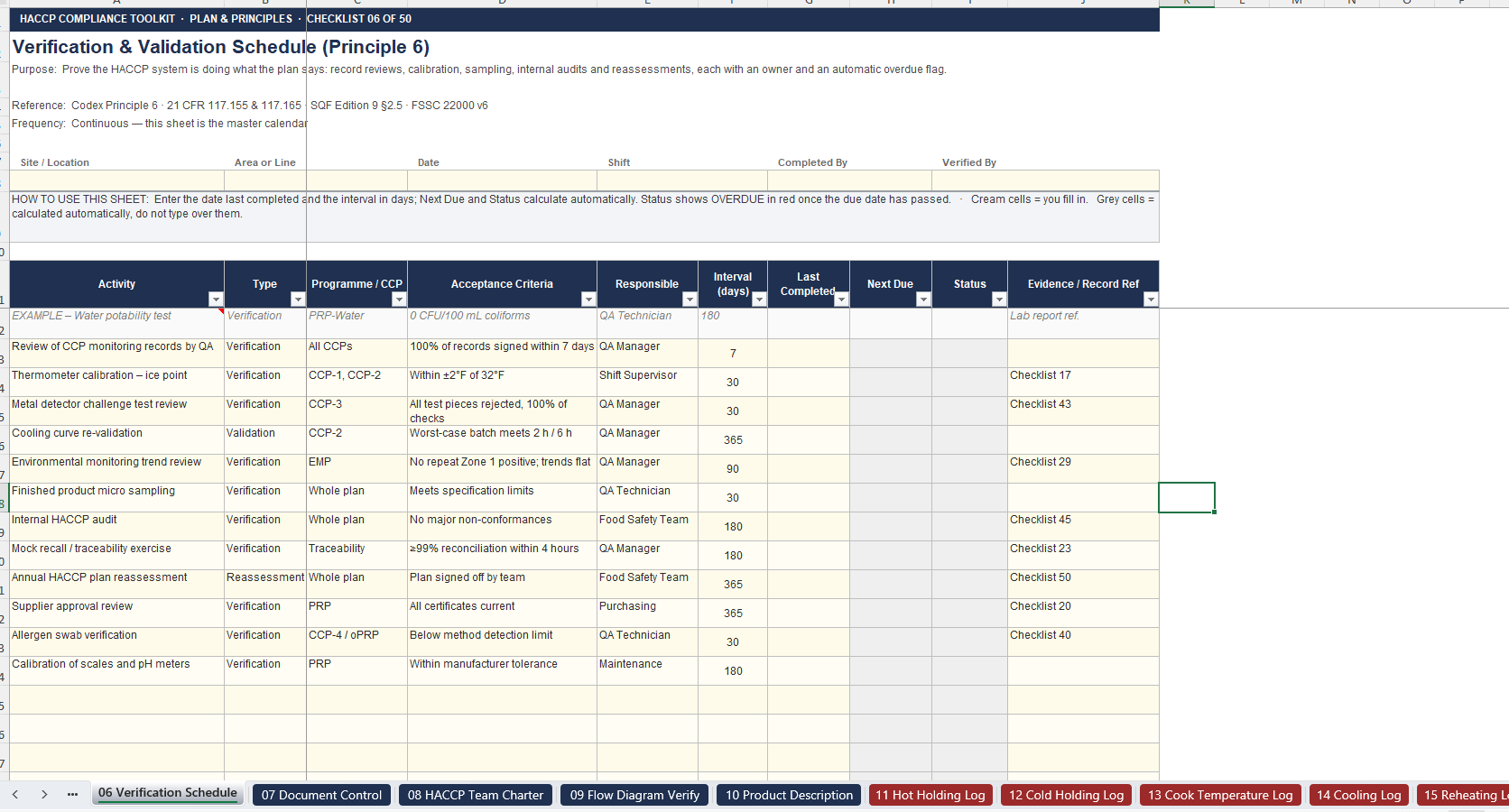
HACCP plan and the seven principles (checklists 1–10)
Hazard analysis worksheet with automatic risk scoring, Codex CCP decision tree,
critical limits and validation register, CCP monitoring plan, deviation log, verification
schedule, document control register, HACCP team charter, flow diagram verification and
product description form.
Time and temperature control (11–18)
Hot holding, cold holding, final cook, two-stage cooling, reheating, refrigeration and
freezer units, thermometer calibration, and time as a public health control. Enter a
reading in °F and the sheet converts to °C, compares it to the critical limit and returns
PASS or FAIL on the spot.
Supply chain and traceability (19–25)
Receiving inspection, approved supplier register with certificate expiry countdown,
storage inspection, an FSMA 204 CTE/KDE traceability record, mock recall exercise with
reconciliation scoring, date marking audit and waste log.
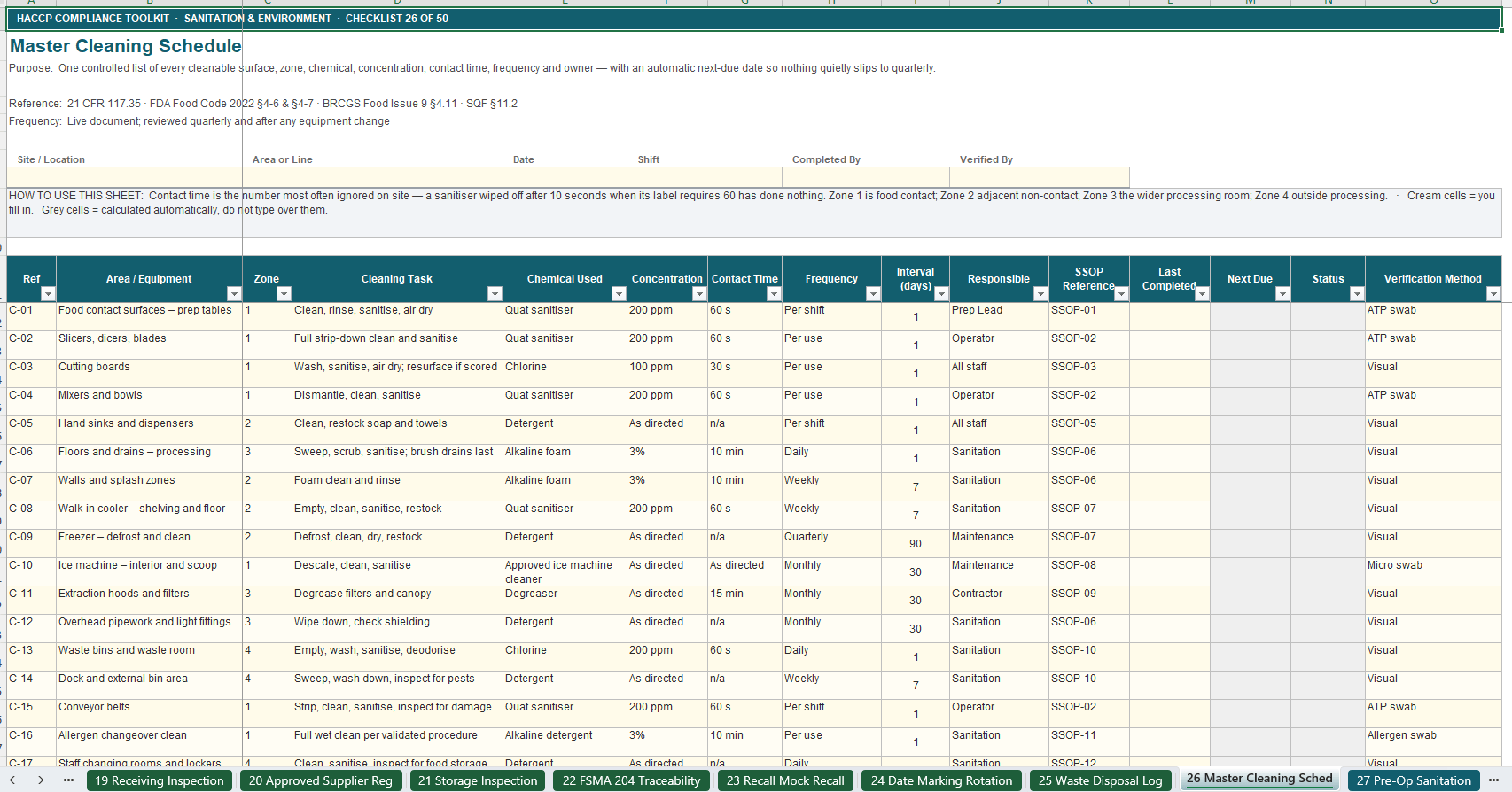
Sanitation and environment (26–33)
Master cleaning schedule with automatic next-due dates, pre-operational sanitation
release, sanitiser titration log, zone-based environmental monitoring for Listeria and
Salmonella, pest control and IPM, CIP verification, water and ice safety, and equipment
preventive maintenance.
People and hygiene (34–39)
Employee health and reporting agreement tracker, daily personal hygiene check,
handwashing observation audit, glove and bare-hand-contact audit, training matrix with
competency scoring, and visitor and contractor log with tool reconciliation.
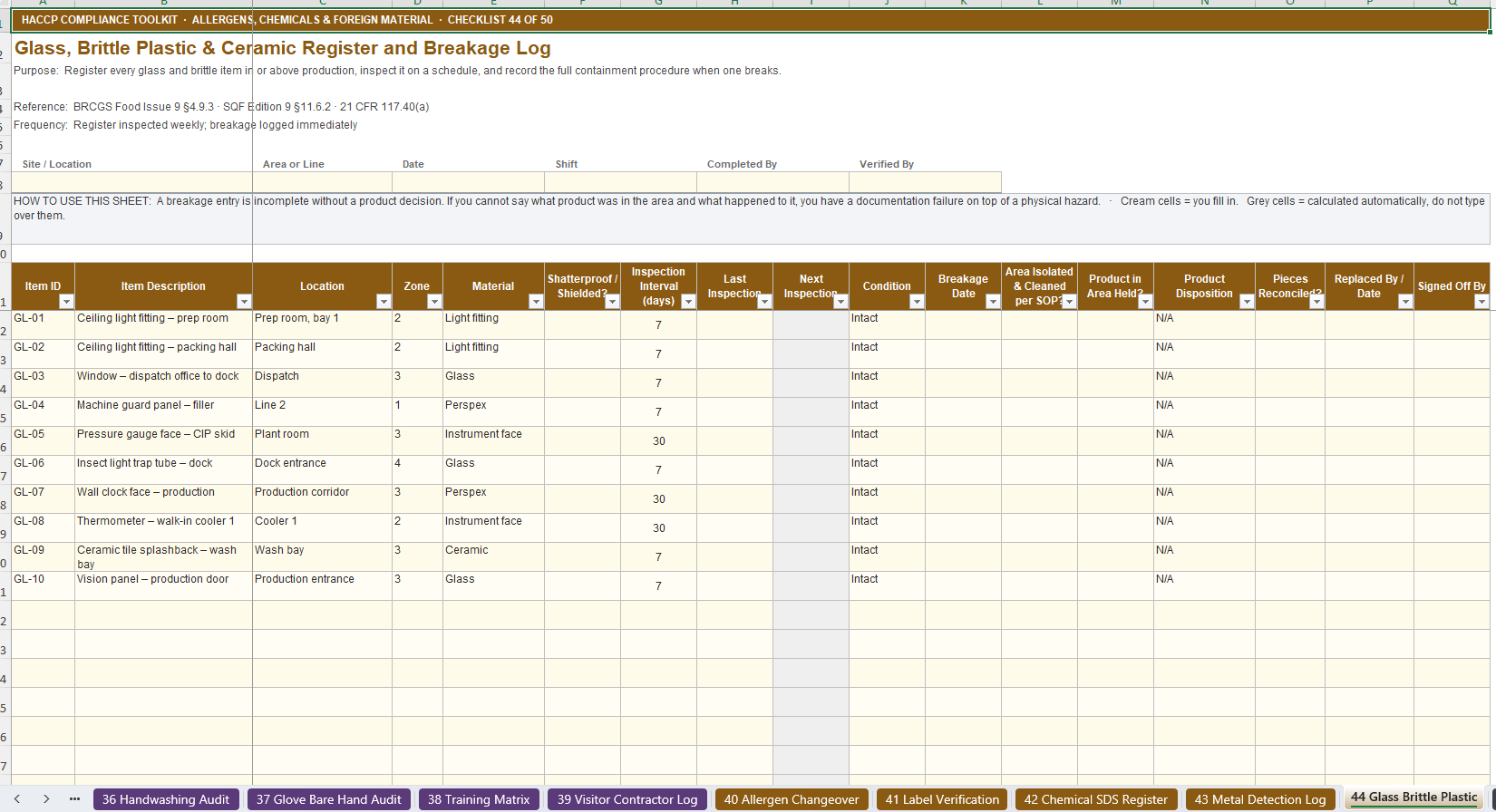
Allergens, chemicals and foreign material (40–44)
Allergen changeover verification covering the nine US majors including sesame and the
fourteen EU allergens, label and packaging verification, chemical and SDS register, metal
detector and X-ray challenge log, and a glass and brittle plastic register with breakage
procedure.
Audit, verification and review (45–50)
Internal HACCP and GFSI readiness audit, health inspection self-assessment built around
the CDC risk factors, CAPA tracker, food defense vulnerability assessment under 21 CFR 121,
customer complaint investigation, and the annual reassessment and management review.
What makes these different from a printable PDF
- The records calculate. Pass and fail verdicts, °F to °C conversion,
cooling elapsed time against the 2-hour and 6-hour rules, hazard risk scores, days to
certificate expiry, next-due dates and compliance percentages are all live formulas. - One event per row. Records are long-format, not locked into a weekly
grid, so a year of monitoring data can be filtered, sorted and pivoted instead of retyped
into a summary. - Controlled vocabularies. Dropdowns keep the night shift recording the
same way as the day shift. PASS turns green, FAIL turns red, OVERDUE turns red, DUE SOON
turns amber. - Every sheet cites its source. The regulation or scheme clause behind
each record is printed on the sheet, so you can answer “why do you do it this way?”
without leaving the page. - Print or tablet. Landscape, fit-to-width, repeating headers, page
footers. Works on a clipboard or on the floor on an iPad.
Who it is for
QA and food safety managers, HACCP coordinators and PCQIs, restaurant and multi-site
operators, central kitchens and caterers, small and mid-size food manufacturers, bakeries,
butchers, produce packers, food safety consultants building a client system, and anyone
preparing for an SQF, BRCGS, FSSC 22000 or health department inspection.
What you get
- One .xlsx workbook, 53 tabs, fully unlocked and editable
- Cover sheet with setup instructions and a clickable index
- A quick-reference sheet of critical limits with the clause behind each one
- An example row on every sheet showing the expected format
- Instant download. One payment, lifetime use, no subscription.
Before you buy
The critical limits supplied are the common regulatory defaults, drawn mainly from the
FDA Food Code 2022 and expressed in °F. If you operate under EU 852/2004, the UK FSA,
Canada’s SFCR or another framework, replace them with yours — every cell is unlocked so
you can. These are documentation templates and a documentation aid; they are not
regulatory, legal or food safety advice, and using them does not by itself make an
operation compliant.
Related products
-
Sale!
Pugh Matrix Template for Excel and Google Sheets — Complete 5-Workbook Suite
Original price was: $49.99.$19.99Current price is: $19.99. Add to cart -
Sale!
350 Project Management Templates Bundle — Mega Excel Templates Bundle with Visual Dashboards
Original price was: $49.99.$29.00Current price is: $29.00. Add to cart -
Sale!

Six Sigma Project $86,000 Cost Reduction in 10 Months
Original price was: $79.99.$49.99Current price is: $49.99. Add to cart -
Sale!

Kaizen & Continuous Improvement Templates — 10 Excel Workbooks with Dashboards
Original price was: $49.99.$29.99Current price is: $29.99. Add to cart